

Why Uplink Capacity Planning Is Becoming Critical in Modern Networks

Share

For years, network design prioritized downlink capacity because consumer traffic was primarily downlink-oriented.
Streaming, browsing, and content consumption shaped planning assumptions; RAN resources for downlink were prioritized to guarantee a downlink-dominant traffic mix, while the uplink was often modeled using simplified rules.
This reality has changed; bidirectional applications and new uplink-heavy use cases require explicit uplink capacity analysis.
The Shift: Users Are Now Generating Data — Not Just Consuming It
User and device behavior have fundamentally changed.
Today’s networks are defined by continuous data generation, not just consumption. Both humans and machines are driving this shift:
- Video conferencing and live streaming
- Social media and user-generated content
- IoT cameras, sensors, and monitoring systems
- Robotics, automation, and AI-driven applications
This is not a gradual change — it’s accelerating fast.
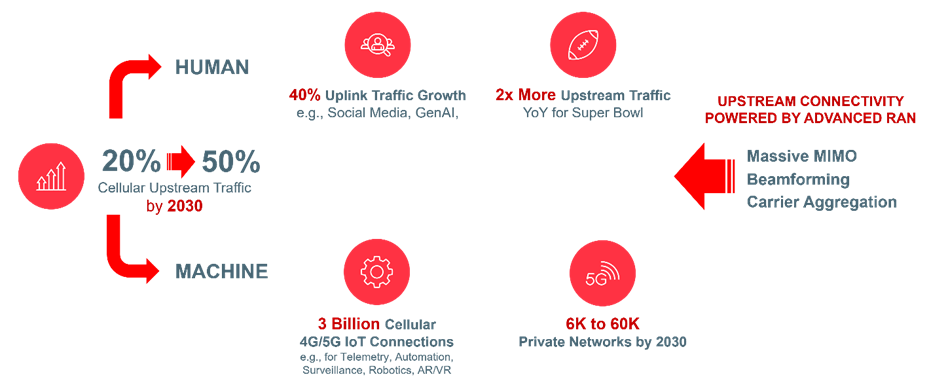
- Uplink traffic is expected to grow from ~20% to nearly 50% of total cellular traffic by 2030
- Upstream demand is increasing by ~40%, driven by real-time applications and content creation
- At large-scale events like the Super Bowl, upstream traffic has doubled year-over-year
At the same time, machine-driven traffic is exploding:
- 3 billion 4G/5G IoT connections expected by 2030
- Growth of private networks from 6,000 to 60,000 globally
Uplink is no longer secondary — it’s becoming core to network performance.
The Reality Gap: Devices Demand More Than Networks Can Deliver
At the same time, device capabilities — and expectations — are increasing rapidly.
Many modern applications require significant uplink throughput:
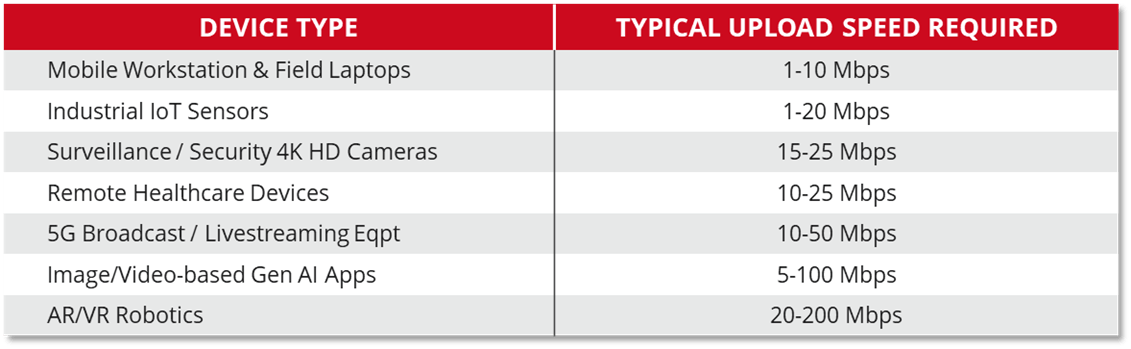
But in many real-world deployments, networks struggle to consistently meet these requirements — especially under load.
This creates a growing gap between expected performance and actual capacity, increasing the risk of:
- Service degradation
- Congestion during peak usage
- Failure to meet SLA expectations
Globally, several countries still struggle with upload speeds.
Where This Matters Most: Uplink-Heavy Environments
While this shift is global, some environments are already feeling the impact more than others.
High-Density Venues (Stadiums, Arenas, Events)
Thousands of users simultaneously uploading videos, streaming live, and sharing content create unpredictable, high-volume uplink demand.
Enterprise and Campus Environments
Video collaboration, cloud workflows, and employee-generated content are driving sustained upstream traffic throughout the day.
Industrial and IoT Deployments
Factories and smart facilities rely on continuous data uploads from:
- Sensors
- Cameras
- Robotics
- Automation systems
These are always-on, mission-critical uplink workloads.
Private Networks
With the rapid expansion of private LTE/5G, uplink is essential for:
- Real-time operations
- Monitoring and control systems
- Data-driven decision-making
What This Means for Network Design
As uplink demand becomes more dynamic and unpredictable, planning approaches must evolve.
Designing for uplink now requires:
- Modeling real user and device behavior
- Accounting for variability and peak scenarios
- Ensuring performance under SLA constraints
This is a shift from:
Static, assumption-based planning → to dynamic, scenario-based modeling
The Challenge: Uplink Planning Hasn’t Kept Pace with Network Evolution
While uplink traffic is becoming increasingly important, many planning approaches still reflect a downlink-first mindset.
In a recent industry poll:
- 40% of respondents said they rely on Excel sheets and other static documents for uplink planning
- 25% do not explicitly design for uplink
- 21% design for downlink first and assume uplink requirements will follow
These approaches may have been sufficient when most traffic was downlink-oriented. However, modern networks are increasingly shaped by video collaboration, user-generated content, IoT devices, automation systems, and private network applications.
Even for teams that already plan for uplink, challenges remain:
- Manual setup of users, traffic profiles, scenarios and KPIs
- Static assumptions that don’t reflect real-world behavior
- Limited confidence that results accurately predict network performance
In fact, manual processes and lack of confidence in the results were identified as the top uplink planning challenges in our survey.
As uplink demand becomes more dynamic and unpredictable, planners need a more realistic way to model network performance and validate results.
The Importance of Simulation-Based Planning
To better reflect real-world conditions, many teams are moving toward simulation-driven approaches.
Instead of relying on fixed assumptions, these methods allow engineers to:
- Model variability across users, devices, and services
- Simulate multiple scenarios automatically
- Capture randomness and peak behavior
- Validate performance using measurable KPIs
This leads to more accurate designs and more efficient workflows.
Enabling Smarter Uplink Planning with iBwave
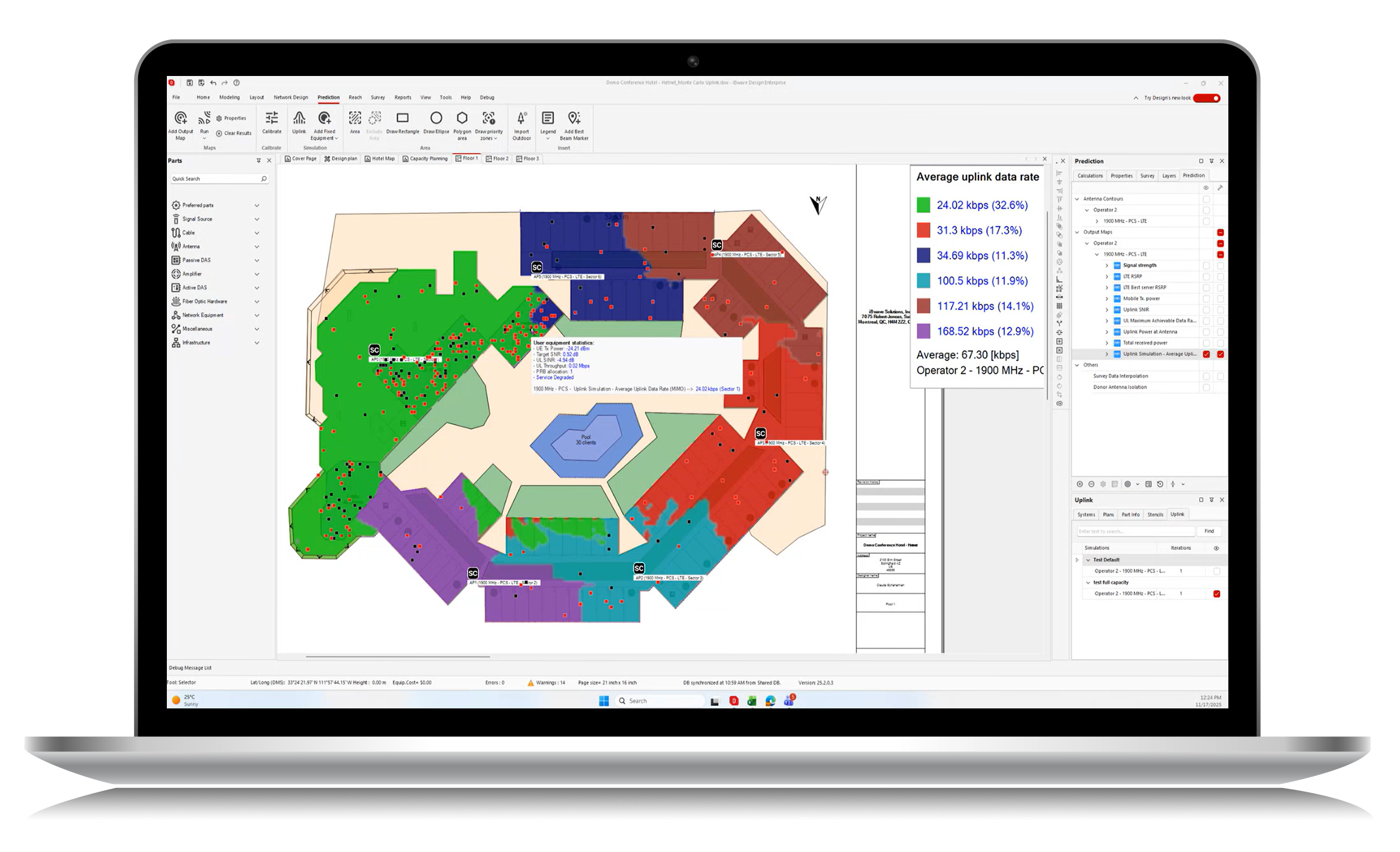
To support this evolution, iBwave has introduced the Uplink Capacity Module, bringing Monte Carlo–based simulation into iBwave Design and Private Networks.
What Is Monte Carlo Simulation and Why It Matters
Traditional planning methods rely on fixed scenarios — for example, a set number of users with predefined behavior in specific locations.
In reality, network usage is far more dynamic:
- Users move and cluster unpredictably
- Devices connect and generate traffic at different times
- Traffic demand fluctuates constantly
Monte Carlo simulation addresses this by running multiple iterations with randomized conditions.
Instead of a single result, it:
- Simulates many possible scenarios
- Models radio conditions such as path loss and interference
- Varies user locations, densities, and traffic patterns
- Evaluates performance across all these variations
This produces a range of outcomes, helping engineers understand:
- Likely performance under normal conditions
- Behavior under peak demand
- Probability of meeting SLA targets
For uplink planning — where variability is high — this approach provides more realistic and reliable results than static modeling.
This enables teams to:
- Simulate different user profiles
- Model realistic traffic and device behavior
- Validate the uplink performance with built-in KPIs
- Design capacity faster with more accuracy & confidence
Preparing for What’s Next
As networks continue to evolve, uplink performance will play a growing role in:
- User experience
- Operational reliability
- SLA compliance
Designing for this future requires a shift:
- From fixed assumptions → to dynamic modeling
- From manual workflows → to automated simulation
- From estimation → to validation
Teams that adapt early will be better equipped to design networks that perform in real-world conditions.
Want to see how this works in practice?
iBwave delivers the simplest and most reliable solution for planning, designing, and delivering private, high-performance networks for smart cities and beyond.
Learn more about Uplink Capacity Simulations in iBwave or watch our short demo below to see how uplink capacity simulation is applied in real projects.
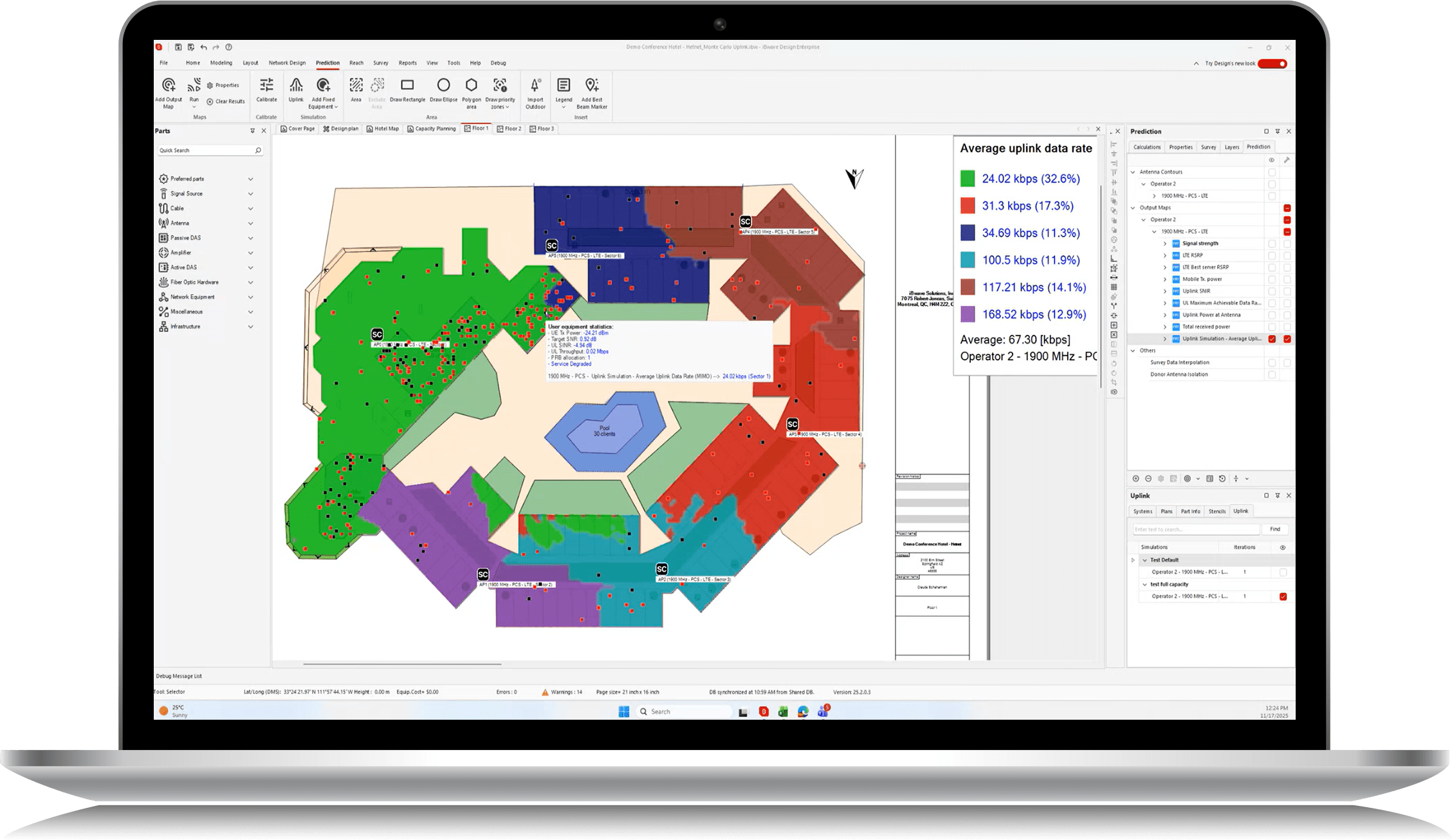
Watch our short demo to see how uplink capacity simulation is applied in real projects.

Gloria Arevalo has been in the telecommunications industry for more than 19 years.She has collaborated in network design and optimization projects to launch cellular networks for various operators in the Americas.Gloria has an Electronics and Communications Engineering degree from Universidad Simon Bolivar in Mexico and her Masters from University of Waterloo in Canada.