

The Three Hidden Killers of Industrial RF

Share

Industrial RF rarely fails because of private 5G speeds, spectrum strategy, or shiny Industry 4.0 use cases.
That is not what usually breaks an industrial network.
In factories, warehouses, and logistics facilities, RF failure is rarely glamorous. It is usually something much more ordinary and much more damaging. A metal surface that should have been harmless. A signal path that never behaved the way the model said it would. A cable run that looked fine on paper but quietly ate the link budget across a massive footprint.
If you are designing industrial RF for “good enough,” you are already in trouble. In these environments, the network is tied to production, safety, automation, and uptime. When RF gets sloppy, operations feel it fast.
Here are three of the most overlooked killers of industrial RF performance, and why they matter a lot more than most teams want to admit.
How PIM Damages Industrial RF on the Shop Floor
PIM is one of those problems that is commonly treated like a tower-site issue or a hardware datasheet footnote. In industrial RF deployments, that mindset gets expensive.
The PIM that occurs within the actual transmission line, its components, or antenna systems is commonly caused by defects, inadequate installation, or the failure to select low-PIM components.
On the other hand, the shop floor is full of non-linear metal objects that cause PIM, such as corroded or oxidized surfaces, on-site hardware (loose brackets, racks, walkways), heavy machinery and dissimilar metals. All the stuff that makes a plant look like a plant can also behave like an accidental RF mixer. That is when you start generating interference products that land right where you do not want them, usually in the uplink, where receivers are already working with weak signals.
And that is the part that is often underestimated. The downlink can look respectable while the uplink is quietly getting wrecked.
You do not fix that by relying solely on a good coverage plot. You fix it with disciplined component selection during the Design process, low-PIM installation practices, proper grounding, and field validation. If the deployment only checks VSWR and calls it a day, that is not enough. PIM is exactly the kind of problem that hides until production traffic shows up and the network starts behaving like it has a personality disorder.
In Industrial 5G, the Signal Usually Goes Around the Problem, Not Through It
This is where many designs fall apart.
People still lean too heavily on basic wall-loss logic, as if a factory were an office with thicker walls. It does not. A manufacturing site is a moving RF maze. Machines are not just obstacles. They are irregular metallic bodies with edges, gaps, angles, and reflective surfaces that cause the signal to attenuate, reflect, and diffract in ways that simple models struggle to predict.
This is critical because it impacts the antenna placement and sectorization. It is important to know whether you can trust a path at all when a line is reconfigured or a large asset gets moved six meters to the left.
This is why serious industrial RF design needs high-fidelity 3D modelling. Not a rough sketch. Not a floor plan with generic attenuation values. A real digital representation of the facility, including structural elements and major equipment geometry. If you are not modelling how the signal behaves around metallic surfaces and challenging spaces between assets, then the overall performance of the network will be affected.
Cable Loss Across Massive Footprints
This one gets less attention than it deserves, mostly because it is not exciting.
But in a two-million-square-foot warehouse or a large industrial campus, cable and transport loss can quietly wreck system balance. The distance between the 5G core, distributed equipment, and radio units is not just a logistical detail. It has direct RF consequences.
If loss is not modelled correctly across fibre or coax runs, you end up with uneven effective power, inconsistent performance, and classic near-far behaviour. One part of the network is shouting. Another part is whispering. Coverage maps may still look acceptable at a glance, but the live network becomes unpredictable, and issues like signal attenuation and SNR degradation start showing up.
This is also where design shortcuts become painfully visible. If cable lengths are loosely estimated, if fibre and coax budgets are treated as back-office details, or if equipment placement is driven more by convenience than by link balance, the network performance will suffer at one point, usually during commissioning, sometimes after go-live, which is worse.
What 99.999% Reliability Actually Takes.
Five nines gets tossed around far too casually.In industrial RF, it is not a slogan. It is a design discipline.
First, you build a digital twin. That means a detailed model of the facility, not just the walls, but the beams, pillars, production zones, storage areas, and major metallic obstructions that shape propagation. Then you use it the right way. Not just for first-pass coverage, but for what-if analysis. What happens if racks move? What happens if a new machine line is added? What happens when density changes and more devices come online in one zone?
Second, designing for downlink and uplink capacity is as critical as designing for coverage. A factory may have thousands of sensors, mobile workers, handhelds, AGVs, cameras, and control devices competing for airtime. If the network meets only a signal threshold and ignores traffic density, data rate behavior, and interference resilience, it is not finished. It is fragile.
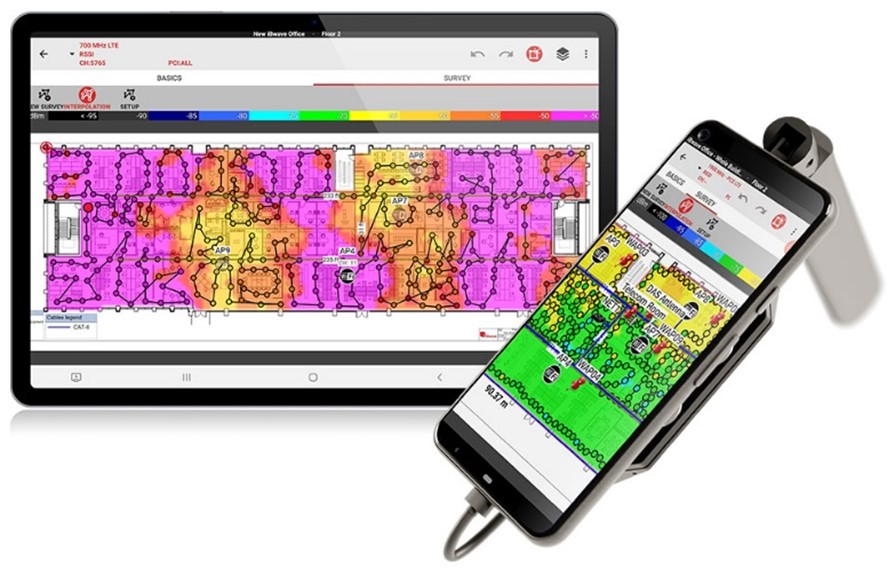
Third, you validate on a grid. This is where mature teams separate themselves from optimistic ones. Post-deployment testing should not stop at signal strength. You need to measure metrics that reflect real operational performance: SINR, interference behaviour, and consistent data rates across the floor. A network that looks healthy in one dashboard and stumbles in the corners is not reliable. It is half-verified.
The Real Problem With “Good Enough”
“Good enough” design is fine for guest Wi-Fi in a low-risk environment. It is a bad habit in industrial RF.
When the wireless network supports automation, monitoring, safety workflows, or production visibility, failure is no longer an IT nuisance. It becomes an operations problem. That changes the design standard. It should.
The teams that get industrial RF right do not obsess over peak speed slides. They obsess over the details commonly overlooked: PIM sources, diffraction paths, cable losses, capacity under load, and post-installation validation. This is the right mindset.
Because industrial RF is not just about getting devices online. It is about making sure the facility keeps moving when the stakes are real.
Ralf has more than 28 years of experience in telecommunications and more than 14 years of experience in a people management role.
Ralf graduated with a diploma in Telecommunications on “Indoor wireless Coverage solutions” in Germany in 1995 and started his wireless career as Radio Design Engineer at Motorola in Hungary and Austria.
Working for System suppliers and network operators in various countries, he developed strong intercultural communication and relationship skills, functional & technical know-how and essential business skills.
In his different roles for global network operators he gained expertise as Network Design Engineer at VIAG Interkom (now Telefonica) in Germany in year 1997, followed by RF Planning & Network Optimization Manager at tele.ring (now t-mobile) in Austria in year 2000, followed by Head of Radio Network Planning & Optimisation at Hutchison 3G Austria in year 2001.
In 2006, Ralf joint Shyam Telecom GmbH in Germany in his role as Chief Technical Officer, responsible for the European business of the Indian based network equipment supplier ShyamTelecom for radio signal enhancement and IP backhaul solutions.
During his career, Ralf continuously participated at conferences and tradeshows as a delegate and speaker.
Ralf joined iBwave in year 2015, responsible for Sales Engineering for Central & Eastern Europe, UK and Nordics. He is also an iBwave certified instructor for In-Class training courses.
- The Three Hidden Killers of Industrial RF - July 24, 2026
- Troubleshooting LTE & 5G Networks in Complex Environments - January 13, 2026
- How to Design Wireless Network for Stadiums: Key Insights and Strategies - July 18, 2024